Guidelines

Submission Preparation Checklist
As part of the submission process, authors are required to ensure that their manuscript complies with all the items listed below. Submissions that do not adhere to these guidelines will be returned to the authors.
-
The submission has not been previously published, nor is it under consideration by any other journal (or an explanation has been provided in the Comments to the Editor section).
-
The submission file is in OpenOffice, Microsoft Word, RTF, or WordPerfect format.
-
URLs are provided for all references where available.
-
The text is single-spaced; uses 11-point Calibri font; employs italics instead of underlining (except for URLs); and all illustrations, figures, and tables are placed within the text at appropriate points rather than at the end.
-
The text adheres to the stylistic and bibliographic requirements outlined in the Author Guidelines.
-
Articles must follow the general format for the presentation of scientific papers and should be submitted to the Editor of the Journal of Economic Sciences at the following email address: rce@ues.edu.sv.
Once the Editor of the Journal of Economic Sciences receives the manuscripts, they will undergo an evaluation process according to the following criteria:
-
Style, content, and scientific originality.
-
Presentation and technical language specific to the field.
-
Only unpublished articles will be accepted.
-
All correspondence must designate only one author as the main contact.
-
The journal accepts scientific articles written in Spanish.
-
Authors should be listed in order of importance according to their contribution to the published article, and must include the following information: full name, institutional affiliation, email address, and ORCID code.
-
The final version of the scientific article must be submitted through the Open Journal System platform of the journal; submissions through other means, whether printed or electronic, will not be accepted.
-
The Editor and the Scientific Committee reserve the right to approve, reject, or suggest revisions to any article, based on the results of the peer review process.
Once the suggested revisions from the peer reviewers have been sent to the corresponding author, they must address the comments and upload the revised document to the system within a maximum period of one month. Authors have the right to appeal reviewer comments, but such appeals must be submitted in writing and supported with scientific evidence.
Articles submitted by national or international authors not directly affiliated with the University of El Salvador must obtain publication authorization from the institution funding the research, in cases where the study was supported by a grant.
Authors are responsible for any potential conflicts arising from authorship or third-party claims related to the works published in the journal.
General Format for the Presentation of Scientific Articles
-
Articles must be submitted in OpenOffice, Microsoft Word, RTF, or WordPerfect format.
-
Articles should not exceed 8,000 words or 20 pages, including tables, figures, and references.
-
The text must be written in a single column, using Times New Roman, 11-point font, and single spacing.
-
Margins should be 2.5 cm on all sides (left, right, top, and bottom).
-
Pages should be numbered in the lower right corner.
-
Tables should be prepared with appropriate descriptions.
Tables
A table is used to present numbers and/or text in columns and rows, following the corresponding formatting standards ________________________.
Each table must include the following elements in this order: table number, title, header, body, and footnote (if necessary).
-
The title should be clear and concise.
-
Acronyms and abbreviations must follow international technical standards; otherwise, they should be explained in a footnote.
-
If a table extends beyond one page, the header row must be repeated on each additional page. Landscape orientation may be used when the table is too wide to fit in portrait format.
Example:
Table 1
The title should be brief, clear, and explanatory.

Note. Include a footnote if necessary.
Figures
Figures include graphs, diagrams, maps, photographs, hand-drawn drawings, and illustrations. They must be presented in accordance with APA standards.
Figures should contain the following elements: figure number, title, image, legend, and note (if necessary).
-
Titles must be concise and explanatory.
-
Maps must include at least one graphic scale that maintains proportional measurements.
-
Photographs must be of good quality and should be attached to the submission in JPG, PNG, or TIFF format.
Example
Figure 1
The title of the figure should be concise and explanatory.
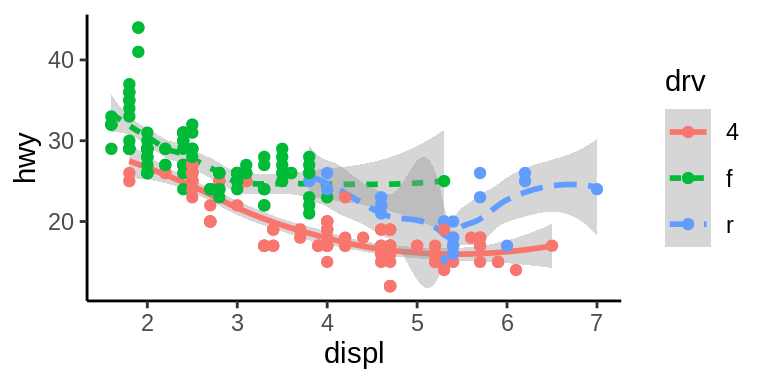
Note. Illustrative figure, taken from RPubs.
Citations
Citations are an essential part of any scientific article submitted for publication in the Journal, not only to ensure proper acknowledgment of other authors’ scientific contributions but also because they provide evidence of the dialogue between different areas of knowledge. The citation style used by the Journal follows APA 7th Edition guidelines.
Example: (to be modified according to the selected style)
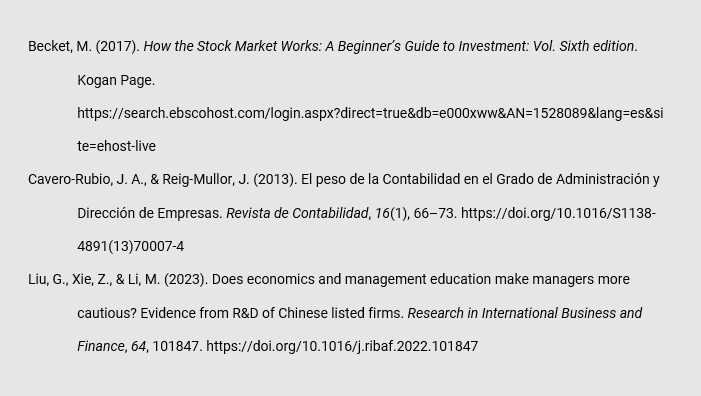
Citation with one author (Cavero-Rubio & Reig-Mullor, 2013), two authors (Liu et al., 2023), and more than two authors (Becket, 2017).
Journal Sections
-
Articles
-
Case Studies
-
Review Articles
-
Outreach Notes
Content of Submitted Works
Table 2
Content of the submitted works according to the section of the Journal

General Elements of an Article
Title, authors, affiliation, institutional email, and ORCID code
Full title of the research paper. It should contain a maximum of 15 words and include the title translated into English.
Authors and affiliation. These should be placed immediately below the title of the research paper, listed according to their scientific contribution to the work, not in alphabetical order. Academic degrees and hierarchical positions should not be included.
Resumen and Abstract (in English). The abstract should not exceed 200 words and must include its English translation (Abstract). It should be sufficiently concise and informative to allow the reader to identify the content and relevance of the paper and decide whether to read it in full. It must be written in the past tense, referring to the place and date of the research, and should include the methodological procedure, summarized objectives, and only hints of the main results and conclusions.
At the end of the abstract, a series of terms known as “keywords” (Key words) must be included, by which the article will be indexed in databases. Use a maximum of five keywords, capitalizing only the first letter of the first word, and list them in order of importance.
Introduction. This section functions as a literature review, referring to previous studies conducted on the research topic and including the most relevant scientific references. All statements and arguments must be supported by bibliographic citations.
It should describe the relevance of the topic in the current scientific context and provide a brief overview of the state of knowledge in the field. It should not be too extensive and must answer the question: “Why was this research conducted?” The last paragraph should summarize the research objective.
Methodology. This section must include the location of the research in space and time, environmental conditions, study units, data collection methods, economic analyses, and statistical analyses (variables studied, models, and statistical tests, as applicable to the research type). Established and well-known methods should be supported with bibliographic references.
Results and Discussion. This section presents the findings in an organized manner, representing the true contribution of the research. Tables and Figures may be included. The order of presentation does not have to be strictly chronological but should provide a coherent and clear explanation of the results obtained. The results of the experiments described in the Methodology should be presented clearly and concisely. The first paragraph should summarize, in a clear and direct sentence, the main finding of the study. This section should be written in the past tense. Units of measurement must follow the International System of Units (SI), and all abbreviations should be clearly defined in accordance with international standards.
The discussion should examine the results, their meaning, and their limitations, emphasizing the new and important aspects of the research. It should determine whether the findings are consistent with or contradictory to existing data.
Conclusions. This section is the core of the scientific article.
Conclusions must logically summarize the results. They should be independent, specific, and non-redundant.
They must be based on the findings of the study, not speculative or derived from literature.
They should align with the objectives established in the research.
Tables or figures should not be mentioned here.
They should not be confused with recommendations.
Do not use numbers or bullet points.
Acknowledgments. This applies to institutions or individuals who supported the research. Any publication funded by the University of El Salvador must include the following statement:
“This research was carried out with the financial support of the University of El Salvador, Central America.”
References. Only bibliographic references that are directly cited in the manuscript may be listed under this heading, and they must follow APA 7th Edition guidelines. At least 60% of the references used should be from the last five years.
Examples: (to be modified according to the selected citation style)
Review Article
Review articles provide a comprehensive summary of research on a specific topic and offer a perspective on the current state of the field and its future direction. Reviews are often widely read (for example, by researchers seeking a complete introduction to a field) and highly cited.
Outreach Notes
This section contains informative reports, bulletins, and any relevant national or international economic information of current interest. Its publication is considered a pre-print, as it will not undergo the peer-review process.
Conflict of Interest
Any potential conflicts of interest arising from the manuscript submitted for publication must be disclosed.
Evaluation Process
Once the submission has been made, the Editor of the Journal of Economic Sciences will review it within 15 days. If deemed of interest and compliant with the criteria outlined in the author guidelines, the manuscript will proceed to the next stage: peer review. The manuscripts are evaluated using the traditional double-blind peer review system, ensuring mutual anonymity between the reviewer and the author(s).
The journal assigns the review process to subject matter experts, who may be members of the Journal’s Scientific Committee and/or external reviewers. Based on the review reports, the journal’s editor will make the final decision on whether to accept or reject the manuscript.
Please note that even after passing the peer-review process, a submitted paper may still be rejected if the journal’s Editorial Board considers it poorly written, inconsistent, repetitive, incomplete, or containing inaccurate or inappropriate statements or bibliographic errors.
The editorial team will notify the authors of the evaluation results and the editor’s final decision, whether to accept or reject the article.
Once an article has been accepted, it will undergo a style editing process before layout and formatting. Throughout all stages of the editorial process, the corresponding author will interact directly with the journal’s editorial team.