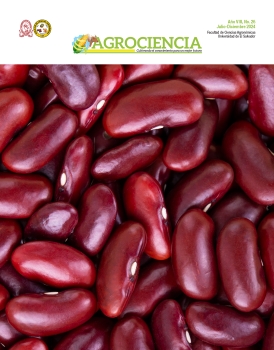
Seed increase of 26 mutant lines of common red bean (Phaseolus vulgaris L), in the month of November, San Luis Talpa, La Paz, El Salvador
Keywords:
Basic grains, Legumes, Plant breeding, Climate changeAbstract
With the aim of increasing the seed of 26 mutant lines of red common bean (Phaseolus vulgaris L), two 90 m2 plots were established in the “La Bomba” lot of the Experimental and Practice Station (EEP) of the Faculty of Agricultural Sciences, University of El Salvador in San Luis Talpa, La Paz, from November 2020 to February 2021. The sowing design of each line was in furrows 5 meters long and a distance between furrows of 0.40 m and between plants of 0.05 m, which represents a density of 500,000 plants. ha-1. All seeds of the lines were treated with Nano gro®, before sowing, except for the control. For the proper development of the different lines, good management practices were carried out, including weed control, irrigation, fertilization, pest and disease control. Descriptive statistical methods, Pearson correlation analysis, cluster analysis, Principal Component Analysis (PCA) and Analysis of Variance (ANOVA) were applied under a Randomized Complete Block Design (DBCA). The variables that were significant in the ANOVA were subjected to the Tukey multiple comparison statistical test of means. The entire analysis was carried out with a statistical significance level (alpha) α of 5% (0.05) and through the use of Microsoft Excel spreadsheets and the statistical program SPSS® 25 and Infostat® 2020. In conclusion, there is increased genetic material from the 26 mutant lines of red common bean (Phaseolus vulgaris L), planted in a non-traditional season under climatic conditions with average minimum temperatures of 22.3 ° C and average maximum temperatures of 33 ° C at 50 meters above sea level. Of the 26 common red bean mutant lines studied, lines M09ST16 and M09ST14 had the best yield and 14 lines reported yields greater than 25 qq ha-1, exceeding the national average grain production of 12 to 17 qq. ha-1 and the average seed yield of 37 qq.ha-1.
References
Agtunong, TP; Redden, R; Mengee-Nang, MA; Searle, C; Fukai, S. 1992. Genotypic variation in response to high temperature at owering in common bean (Phaseolus vulgaris L.). Aust. J. Exp. Agric. 32:1135-1140.
CENTA (Centro Nacional de Tecnología Agropecuaria y Forestal, El Salvador). 2019. Cultivo de frijol (Phaseolus vulgaris L.) (en línea). Consultado 21 may. 2021. Disponible en http://centa.gob.sv/docs/guias/granos%20basicos/Guia%20Centa_Frijol%202019.pdf
CIT (Centro de Información Tecnología). 2006. Cultivos con potencial de exportación.
Doria, J. 2010. Generalidades sobre las semillas: su producción, conservación y almacenamiento (en línea). Revista de Cultivos Tropicales, vol. 31. Consultado 20 may. 2021. Disponible en http://scielo.sld.cu/scielo.php?pid=S0258-59362010000100011&script=sci_abstract
Esqueda, V; Durán, A; López, E. 2016. Effect of the time and type of weeding on residual moisture growing beans (Phaseolus vulgarisL.). Mesoamerican Agronomy, 8(1): 59-64.
Faure, B; Benítez, R; León, N; Chaveco, O; Rodríguez, O. 2013. Guía técnica para el cultivo del frijol común (Phaseolus vulgaris L.). Editora Agroecológica, Artemisa, Cuba, 35 p.
González Cepero, MC. 2021. Inducción de mutaciones: Estado del conocimiento en el mejoramiento genético de plantas en América latina y el Caribe: Cuba: Mejoramiento genético en cultivos de importancia económica. Sergio, Santos de los. Sonara, Obregón, CDMX. Fontamara. p. 75-76.
Hernández Monterrosa, JV; Amaya Rivera, MA. 2013. Caracterización Molecular y Morfológica de Accesiones de Germoplasma de Frijol Común de El Salvador (en línea). Tesis Lic. Ing. Agr. Honduras, Zamorano. 28 p.
Jankuloski, L; Forster, BP; Nakagawa, H. 2021. Manual de Mejoramiento por Mutaciones: Mejoramiento de caracteres de importancia por mutaciones. s.e. Spencer-Lopes MM; Forster BP; Jankuloski L. (ed). 3ed. Vienna, Austria. p. C7.150.
Lamz, A; Regla, M; Cárdenas, T; Ortiz, R; Alfonzo, L.E; Sandrino A. 2017. Evaluación preliminar de líneas de frijol común (Phaseolus vulgarisL.) promisorios para siembras tempranas en Melena del Sur (en línea). Consultado 20 may. 2021. Disponible en http://scielo.sld.cu/scielo.php?script=sci_arttext&pid=S0258-59362017000400016.
López, M; Fernández, F; Schoonhoven, A. Van, EDS. (eds.).1985. Frijol: Investigación y producción. Programa de las Naciones Unidas (PNUD); Centro Internacional de Agricultura Tropical (CIAT), Cali, CO. 417 p.
Majd Nasari, B. 2011. Obtenido de Determinación de la fecha de siembra más adecuada, densidad óptima de la planta y disposición del frijol común cultivado en la región de Dehaghan, Irán.
Masaya, P; White, JW. 1991. Adaptation to photoperiod and temperature. In: Common Beans: Research for Crop Improvement. Schoonhoven, AV; Voysest, O (eds). C. A. B. Intl. U. K. and CIAT, Cali, Colombia. pp:445-500.
Meneses, D.P; Segura, H; Estrada, R; Huaringa, A. 2020. Caracterización fenotípica y agronómica de líneas avanzadas de fríjol voluble (Phaseolus vulgaris L.) resistentes a virus en Perú (en línea). Consultado 21 may. 2021. Disponible en http://www.scielo.org.bo/scielo.php?pid=S240916182020000100003&script=sci_abstract.
Monterroso, VA; Wien, HC. 1990. Flower and pod abscission due to heat stress in beans. J. Amer. Soc. Hort. Sci. 115:631-634.
Orellana Núñez, MA; Angel Molina, JX; Martínez Sierra, B; Artiga, D Fernández, J; Alejo, J; de Linares, AY. 2021. Inducción de mutaciones: Estado del conocimiento en el mejoramiento genético de plantas en América latina y el Caribe: El Salvador: Mejoramiento genético de frijol (Phaseolus vulgaris L) y Chipilín (Crotalaria longirostrata). Sergio, Santos de los. Sonara, Obregón, CDMX. Fontamara. p. 103-12.
Padilla, JS; Ochoa, R; Acosta, E; Acosta, JA; Mayek, N; Kelly, JD. 2003. Grain yield of early and late dry bean genotypes under rainfed conditions in Aguascalientes, México. Annual Report of the Bean Improvement Cooperative, 46, P. 89-90.
Singh, S; Gutierres, A; Molina, A; Urrea, C; Gepts, P. 1991. Genetic diversity in cultivated common bean. II. Marker- based analysis on morphological and agronomic traits. Crop Sci. 31:23-29.
Spencer Lopes, M.M., Forster, B.P. y Jankuloski, L. 2021. Manual de mejoramiento por mutación – Tercera edición. Viena, FAO. https://doi.org/10.4060/i9285es
Downloads
Published
Issue
Section
License
Copyright (c) 2025 O.A. Rodríguez-Gracias, J.X. Ángel-Molina, E.A. Vásquez-Osegueda, M.O. Molina-Escalante, H.M. Parada-Flores, K.Z. Orellana-Martínez, F.A. Parada-Berríos

This work is licensed under a Creative Commons Attribution-ShareAlike 4.0 International License.