Population estimate of the Asian citrus psyllid and geographical distribution of Tamarixia radiata as a biological control agent in backyard areas in El Salvador
Keywords:
Diaphorina citri, parasitoid, hostsAbstract
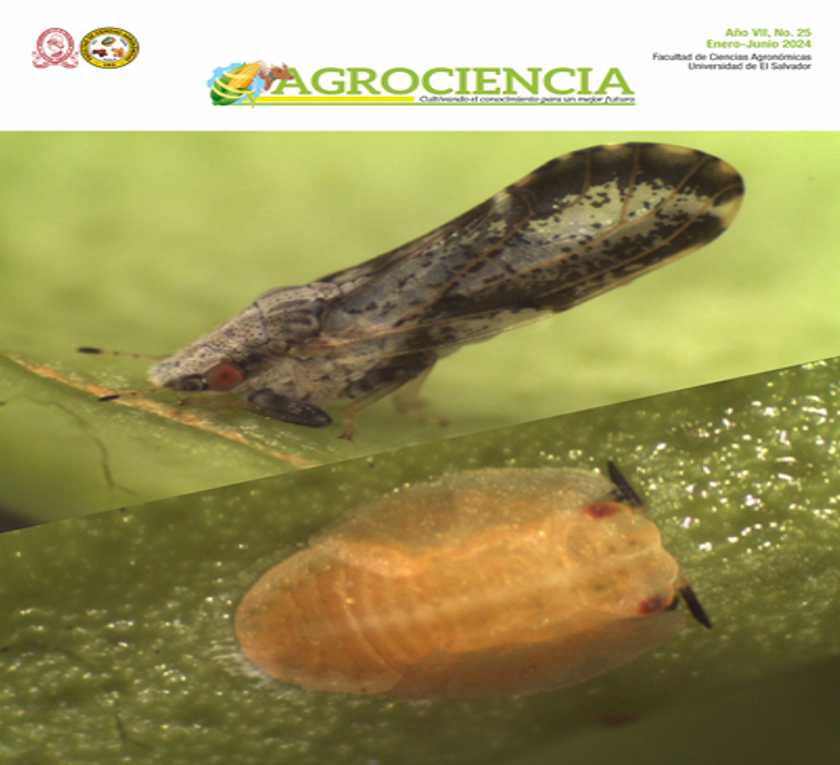
This research was carried out at a national level specifically in backyard areas, selecting attractive hosts associated with the feeding of Diaphorina citri. For this, a list of hosts was defined based on their sprouting frequency and distribution nationwide, mainly in backyard areas. Field visits were carried out between April and October 2019. The objective of the research was to estimate the population of the Asian citrus psyllid and the geographical distribution of the parasitoid Tamarixia radiata as a biological control agent in backyard areas in El Salvador. The field visits were carried out in the three main regions of the country; this required the establishment of exploration and sampling routes on the three main roads of the country. In inspections of backyard trees it was necessary to consider the frequency of sprouting. The recognition and counting of PAC specimens per tree was carried out using 20X entomological magnifying glasses. For this purpose, 15 cm long shoots were inspected, field data were recorded using forms and parasitoid specimens were identified. by the MAG laboratory. Finally, this research aims to generate valuable information to the relevant institutions, regarding the integrated management of Diaphorina citri and the moment in which preventive actions or control measures can be taken in order to reduce the potential risks of Huanglongbing (HLB) of citrus fruits.
References
Asplanato, G; Pazos, J; Buenahora, J; Amuedo, S; Rubio, L; Franco, J. 2009. EL Psílido asiático de los cítricos Diaphorina citri, vector del HLB, problemática y control en el mundo (en línea). Montevideo, Uruguay, INIA. Consultado 10 ago. 2019. Disponible en https://bit.ly/2Z0bOVw Augier, L; Gastaminza, G; Lizondo, M; Arganaraz, M; Willink, E. 2006. Presencia de Diaphorina citri (Hemiptera: Psyllidae) en el Noroeste Argentino (NOA) (en línea). Revista de la Sociedad Entomológica Argentina 65 (3-4): 67-68. Consultado 20 feb. 2019. Disponible en https://bit.ly/2GVGvWC Bové, JM. 2006. HUANGLONGBING: A destructive, newly-emerging, century old disease of citrus. (en linea). Brasil. Consultado 28 oct. 2019. Disponible en https://bit.ly/2q27FEAChiou-Nan, C.1998. Ecology of the Insect Vectors of Citrus Systemic Diseases and Their Control in Taiwan (en línea). Food and Fertilizer Technology Center Publication Database. Consultado 20 feb 2019. Disponible en https://cutt.ly/0r2fC1c Criticas.com. 2019. Controlador biologico: Tamarixia radiata. (en linea). Consultado 05 ene 2020. Disponible en: https://citricas.com/controlador-biologico-tamarixia-radiata/FDASC-DPI (Florida Department of Agriculture and Consumer Services - Division of Plant Industry, Estados Unidos de América). 2008. Adult Asian citrus psyllid, Diaphorina citri (2-3 millimeters long) on a young citrus leaf (en línea, fotografía). Florida, Estados Unidos de América. Consultado 18 mar. 2019. Disponible en https://bit.ly/2TaXtmlFlores Sánchez, JL; Mora Aguilera, G; Loeza kuk, E; Lopez Arroyo, JI; Dominguez Mongue, S; Acevedo Sanchez, G; Robles Garcia, P. 2015. Perdidas en produccion inducidas por Candidatus Liberibacter asiaticus en Limon Persa, en Yucatan, Mexico. Hall, D. 2008. Biology, history and world status of Diaphorina citri (en línea). USDA-ARS, Horticultural research laboratory. Consultado 15 ago 2019. Disponible en https://bit.ly/3dOwqavHernández, 2016. Inverntario de enemigos naturales asociados a Diaphorina citri (kuwayama, 1907) (hemiptera: Psyllidae) en dos fincas de produccion citricola en el departamento de San Salvadorm El Salvador. (En linea). Consultado 20 sep 2020. Disponible en chrome-extension://efaidnbmnnnibpcajpcglclefindmkaj/https://swfrec.ifas.ufl.edu/hlb/database/pdf/19_Hernandez_16.pdfKondo, T. 2017. Protocolo de cría y liberación de Tamarixia radiata (Waterston) (Hymenoptera: Eulophidae) (en línea). Mosquera, Colombia, CORPOICA. Consultado 20 feb. 2019. Disponible en https://bit.ly/2Td0QNmMartínez Carrillo, JL. 2008. Ficha técnica de Diaphorina citri Kuwayama: Psílido Asiático de los Cítricos (en línea). San Luis Potosí, México, SAGARPA. Consultado 5 abr. 2018. Disponible en https://bit.ly/2wM9w0E
MIDA (Ministerio de Desarrollo Agropecuario, Panamá). 2016. Resolución No. OAL-039-ADM-2016 Panamá, 3 de febrero (en línea). Consultado 29 feb. 2020. Disponible en https://cutt.ly/Er60DeT OIRSA (Organismo Internacional Regional de Sanidad Agropecuaria, El Salvador). 2015. Protocolo del Manejo Integrado del Huanglongbing. San Salvador, El Salvador, Taiwán ICDF.Restrepo García, A. M., Arias Ortega, P. L., y Soto Giraldo, A. 2016. Primer reporte de Tamarixia radiata (Waterston) (Hymenoptera: Eulophidae) en el departamento de Caldas, Colombia. Boletín Científico Centro de Museos Museo de Historia Natural, 20(1), 204–210. Disponible en https://doi.org/10.17151/bccm.2016.20.1.15Reyes, R; Cruz, JE. 2007. Diagnóstico del psílido asiático de los cítricos Diaphorina citri Kuwayama (Homoptera: Psyllidae), en fincas y viveros de El Salvador. La Libertad, El Salvador, MAG. 25 p.Sánchez González, J. A; Vizcarra Valdez, N. I;. Moreno Carrillo, G; Alpizar Puente, R. A; Contreras Bermúdez, Y; Sandoval Rodríguez, D. E.; Palomares Pérez, M; González Cabrera, J.; Medina García, N. I.; Cordoba Urtiz, E. G. 2015. Manual de reproducción masiva de Tamarixia radiata. (en línea). Consultado 20 feb. 2020. Disponible en chrome-extension://efaidnbmnnnibpcajpcglclefindmkaj/https://www.gob.mx/cms/uploads/attachment/file/210349/manual_de_reproducci_n_Masiva_de_Tamarixia_Radiata-23-06-2016.pdfSantivañez, P; Mora, G; Díaz, G; López, Vernal, P. 2013. Marco Estratégico para la Gestión Regional del Huanglongbing en América Latina y el Caribe (en línea). Santiago de Chile, Chile, FAO. Consultado 20 feb. 2020. Disponible en http://www.fao.org/3/a-i3319s.pdfSENASICA (Servicio Nacional de Sanidad, Inocuidad y Calidad Agroalimentaria, México). 2013. Huanglongbing Candidatus Liberibacter spp. (en línea). México. Ficha técnica n° 78. Consultado 26 oct. 2019. Disponible en https://bit.ly/367xVy7
Downloads
Published
Issue
Section
License

This work is licensed under a Creative Commons Attribution-ShareAlike 4.0 International License.