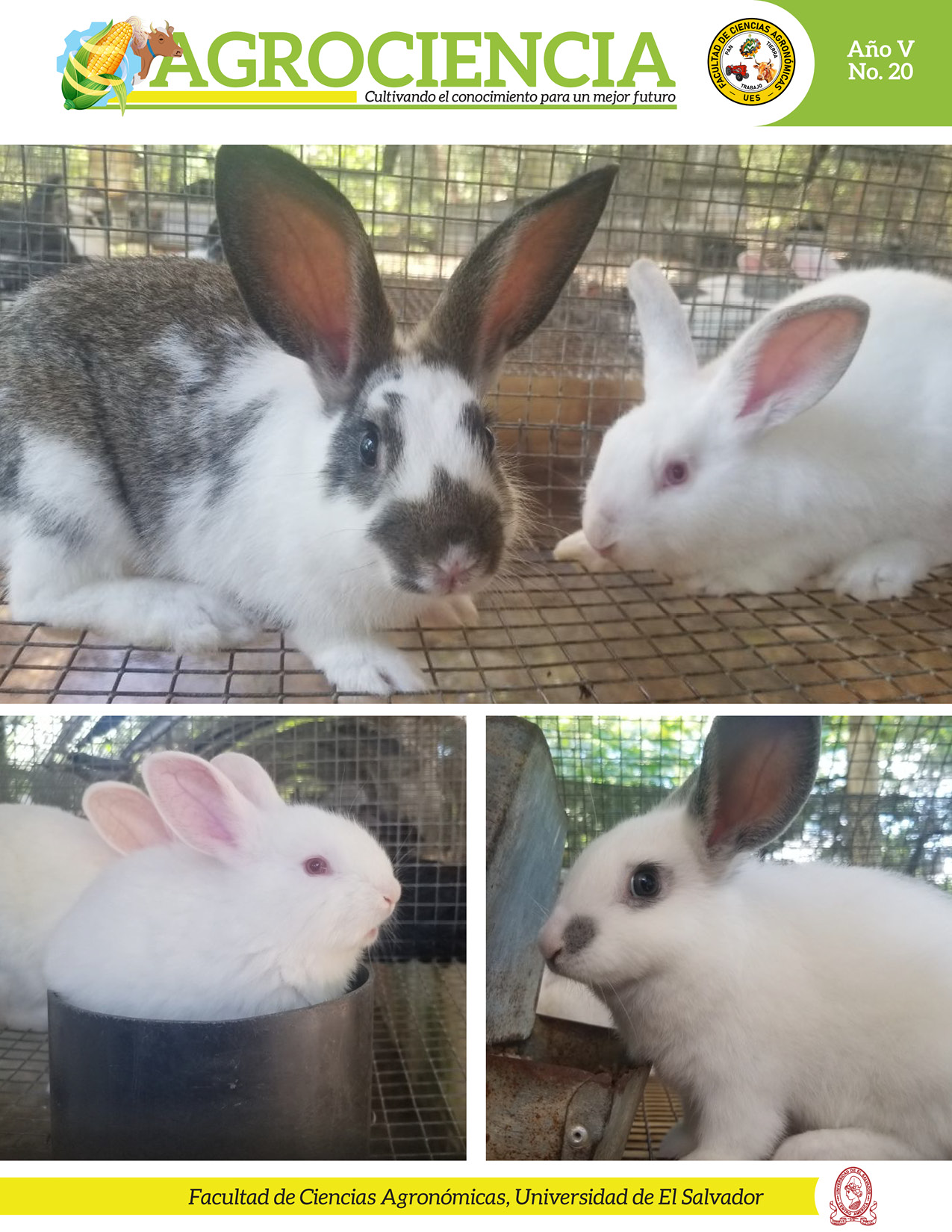
Effect of feeding with ojushte leaves (Brosimum alicastrum Swartz) and chaya leaves (Cnidoscolus chayamansa) on the weight gain of New Zealand fattening rabbits
Keywords:
chaya, ojushte, protein content, rabbitsAbstract
In order to improve the weight gain, carcass yield and the protein content of the meat of New Zealand fattening rabbits, an investigation was carried out in which the daily ration of commercial concentrate was supplemented with 4 ounces of ojushte foliage (Brosimum alicastrum) and chaya (Cnidoscolus chayamansa). This was developed with 18 30-day-old New Zealand breed rabbits housed in cages, through a completely randomized design with three treatments: T0: 4 ounces of concentrate, T1: 4 ounces of concentrate + 4 ounces of chaya leaves, T2: 4 ounces of concentrate + 4 ounces of ojushte leaves. Analysis of variance and test of contrasts were applied to the variables of carcass performance and weight gain, the treatments provided similar effects in these variables. The verification of the quality generated was carried out with a bromatological analysis to quantify the protein content of the meat of the rabbits of the treatments under study. The best final weight was obtained with the T1 with 3.98 pounds at seven weeks fattening. The best carcass performance was obtained with the T0: 2.07 pounds. The highest protein content (18.87%) was obtained in the meat of rabbits supplemented with chaya. In general, the supplementation of the diet of fattening rabbits based on four ounces of commercial concentrate (50%) with four ounces of foliage (50%) of ojushte or chaya is recommended, since they allow to obtain lean, nutritious carcasses and at a lower cost
References
Bivin, S; King, W. 1997. Crianza de conejos saludables. Seattle, Estados Unidos. Christian Veterinary Mission. p. 79-80.
Botero, L; De la Ossa, J. 2003. Guía para la cría, manejo y aprovechamiento sostenible de algunas especies animales: mamíferos herbívoros domésticos. Bogotá, CO. Convenio Andrés Bello. p. 47-49.
CIMMYT (Centro Internacional de Mejoramiento de Maíz y Trigo, MX). 1988. La formulación de recomendaciones a partir de datos agronómicos: Un manual metodológico de evaluación económica. México Distrito Federal, MX. p. 25-31
Deltoro, J; López, A. 1992. Factores que determinan la calidad y el rendimiento en canal. Revista Mundo Ganadero 3(7-8): 70-75
DIGESTYC (Dirección General de Estadísticas y Censos, SV). 2014. Canasta Básica Alimentaria (en línea). San Salvador, SV. Consultado 27 abr. 2015 Disponible en http://www.digestyc.gob. sv/index.php/servicios/en-linea/canasta-basicaalimentaria. html
Gallardo, J. 1979. Efectos nutricionales de la utilización de fibra en las dietas de monogástricos. Barcelona, ES. p. 288-292.
García, M; Fernández, S. s.f. Determinación de proteína de un alimento por el método Kjeldahl valoración con un ácido fuerte (en línea). Universidad Politécnica de Valencia, ES Consultado 5 jul 2015 Disponible en https://riunet. upv.es/bitstream/handle/10251/16338/ Determinaci%C3%B3n%20de%20proteinas. pdf?sequence=
Gonzales, P; Caravaca, F. s.f. Producción de conejos de aptitud cárnica (en línea). Córdoba, AR. Consultado 12 oct. 2015. Disponible en http://www.uco.es/zootecniaygestion/img/ pictorex/09_10_34_Cunicultura.pdf
Gutiérrez, D. 2013. Evaluación del comportamiento productivo de conejos (Oryctolagus cuniculus), en la fase de engorde, alimentados con diferentes niveles de inclusión de forraje chaya (Cnidoscolus sp.). Tesis Ing. Agr. Coban, GT, CUNOR. 47 p
Lebas, F; Coudert, P; Rochambeau, H de; Thébault, R. 1996. Conejo: Cría y Patología. 2 ed. Roma, IT. FAO. p. 15-21.
Lesbouyries, G. s.f. Enfermedades del conejo: Enfermedades infecciosas. Zaragoza, ES. Acribia. p. 295-297
Martínez, R; Santos, R; Ramírez, L; Sarmiento, L. 2010. Utilización de ramón (Brosimum alicastrum Swartz) y Cayana (Hibiscus rosa-sinensis L) en la alimentación de conejo. Zootecnia Tropical. 28(2): 153-161.
Ouhayoun, J. 1992. Factores que determinan la calidad y el rendimiento en canal. Mundo Ganadero 3(7-8):74.
Salvini, S; Parpinel, M; Gnagnarella, P. 1998. Base de datos de composición de alimentos de Estudios Epidemiológicos en Italia (en línea). Istituto Europeo di Oncologia. Milán, IT. Consultado 8 dic. 2015. Disponible en http://www.bda-ieo.it/
Downloads
Published
Issue
Section
License

This work is licensed under a Creative Commons Attribution-ShareAlike 4.0 International License.