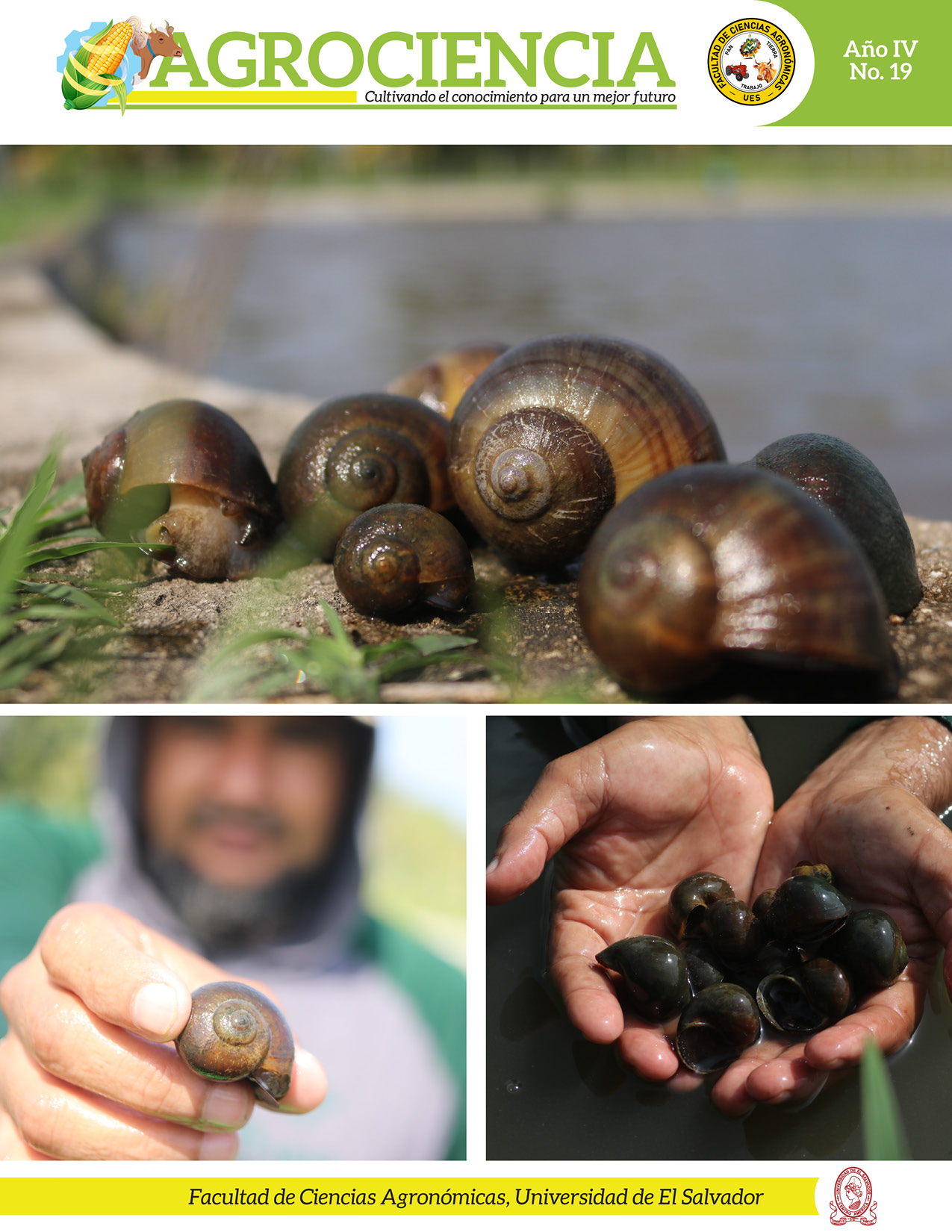
Presence of free-living amoeba in edible snail (Pomacea flagellata Say, 1827) in six bodies of water in El Salvador
Keywords:
Snail, Pomacea flagellata, parasitological diagnosis, free-living amoebaeAbstract
In order to determine the presence of parasites in the edible snail (Pomacea flagellata), samples of this species were taken in six national water bodies from July 2010 to March 2019. Data on the biomass of said snail were recorded and through dissection techniques parasitological diagnoses were made. According to the findings, it can be affirmed that the Cerrón Grande reservoir had the highest total weight (including shell): 27 ± 4.5 grams and the highest weight of edible material (without shell): 11.3 ± 1.4 grams. The highest yield of edible material corresponded to the Nueva Concepción aquaculture ponds: 50.23 ± 1.9%. No metazoans were found in the parasitological diagnoses, but the following protozoa were identified: cysts of the free-living amoebae of Endolimax nana, Iodomoeba butschlii, Chilomastix mesnili and Entamoeba coli. The percentage of said protozoa found in snails was variable: Endolimax nana with 30.00%, Iodamoeba butschlii with 25.83%, Chilomastix mesnili with 17.50%, Entamoeba coli with 4.17% and without any species 22.50%. The main conclusion was the following: the presence of cysts of four species of free-living amoebas was confirmed in the edible snail (Pomacea flagellata) in water bodies of El Salvador
References
Amador-del Ángel, L; Mugartegui Esquiliano, J; Chin Caña, F; Arcos Pérez, A; Cabrera Rodríguez, P. 2006. Características del desove del Caracol de Agua Dulce Pomacea flagellata en ambiente controlado. (tesis). Facultad de Ciencias Pesqueras, Universidad Autónoma del Carmen (México). (en línea). Consultado 12 de Diciembre del 2015. Disponible en: http://www.academia. edu/2568234/Caracter%C3%ADsticas_del_ desove_del_caracol_de_agua_dulce_Pomacea_ flagellata_livescens_Reeve_1986_en_ambiente_ controlado
Benito, M.; LaPlante, D.; Fernández, M.; Lasheras, A.;,Gómez, J.; Peña, M.; Rubio, E.; Goñi, M. 2018. Amebas de vida libre en aguas residuales y fangos: Su papel como reservorio natural de bacterias potencialmente patógenas. Rev. Salud ambiental. 2018; 18(1):69-77.
Iriarte Rodriguez, FV; Mendoza Carranza. M. 2007. Validación del cultivo semi-intensivo del caracol tote (Pomacea flagellata) en el trópico húmedo. México, DARMA, Ecosur. (en linea) consultado 23 Feb 2015. Disponible en www.revistaaquatic. com/aquatic/art.asp 16-17P.
Jiménez, N; Santamaría, J. 2008. Ensayo evaluativo de tres tipos de alimento vegetal en la dieta alimenticia del caracol de agua dulce (Pomacea spp). Universidad de El Salvador. Facultad de Ciencias Naturales y Matemática. Escuela de Biología. 9 P.
Lobo Vargas, X.M. 1986. Estudio de algunos aspectos de la biología del molusco Pomacea flagellata. Tesis. Lic. Biología. Escuela de Biología. Universidad de Costa Rica. CR. P96.
Mallya, Y.J. 2021. Los efectos del oxígeno disuelto en el crecimiento de los peces en la acuicultura. AquaFed. (en línea). Consultado 14 mayo 2021. Disponible en: https://aquafeed.co/entrada/losefectos- del-ox-geno-disuelto-en-el-crecimientode- los-peces-en-la-acuicultura-20548/
MARN-IABIN. Sf. Ficha Técnica-Proyecto Especies Invasoras. San Salvador. 3P.
Oddó Benavides, D. 2006. Infecciones por amebas de vida libre. Comentarios históricos, taxonomía y nomenclatura, protozoología y cuadros anátomoclínicos. Revista chilena de infectología. Pontificia Universidad Católica de Chile. 23 (3): 200-214.
Ozaeta Zetina, M.A. 2002. Evaluación del efecto de tres niveles de alimentación con incaparina, y ninfa acuática (Eichornia Crassipes) en el crecimiento del caracol (Pomacea spp.) en condiciones controladas. Tesis. Ing. Guatemala, Gt. Universidad de Guatemala. 68 p.
Plan Regional de Pesca y Acuicultura Continental (PREPAC). 2006. Caracterización del Lago de Güija con Énfasis en la Pesca y la Acuicultura. (en línea). Consultado 14 de mayo de 2021. Disponible en: http://www.sica.int/busqueda/busqueda_ archivo.aspx?Archivo=odoc_11814_1_22112006. pdf
Reyes Santizo . J. G. 1997. Eficiencia reproductiva en caracoles de agua dulce (Pomacea sp.) en tres diferentes pesos. Tesis. Universidad de Guatemala,p. 6-10.
Solórzano Álava, L. F. 2014. Angiostrongylus cantonensis: un parásito emergente en Ecuador. Revista Cubana de Medicina Tropical. 2014; 66(1):20-33
Downloads
Published
Issue
Section
License

This work is licensed under a Creative Commons Attribution-ShareAlike 4.0 International License.