Productive performance of three sowing densities of white shrimps Litopenaeus vannamei in the Mariculture Station, Los Cóbanos, Sonsonate, El Salvador
Keywords:
Sowing density Litopenaeus vannamei, survival, productive performance, average size, average weightAbstract
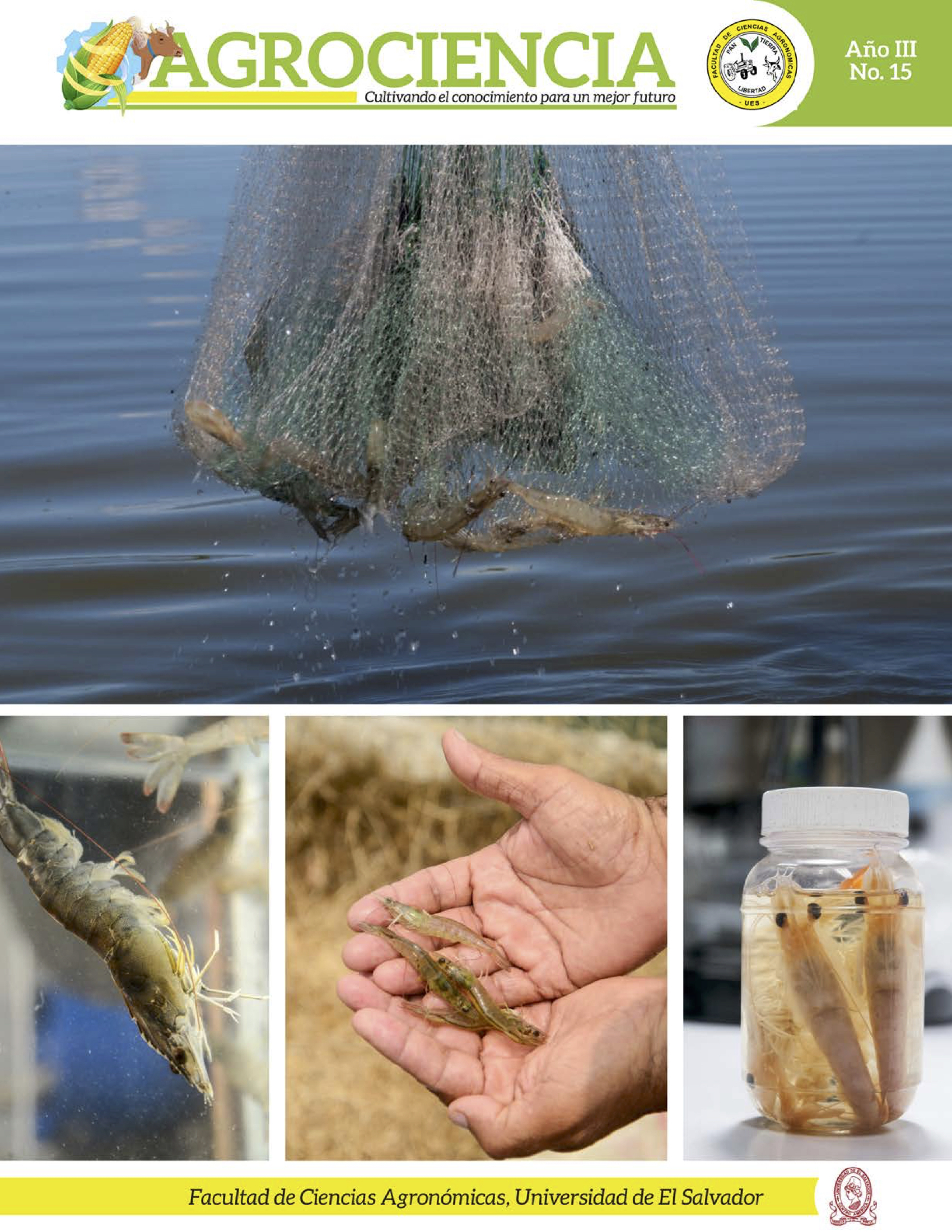
The research was carried out at Los Cóbanos Mariculture Station, a dependency of the Center for the Development of Fisheries and Aquaculture (CENDEPESCA by its Spanish acronym), Ministry of Agriculture and Livestock, in the department of Sonsonate, El Salvador, with a duration of 90 days. evaluated the performance of the white shrimp Litopenaeus vannamei, in three stocking densities, with treatments T1 = 10 shrimp / m2, T2 = 20 shrimp / m2 and T3 = 30 shrimp / m2. The sample universe was 3 geomembrane ponds with 128 m² of surface each; starting with the preparation of the ponds for the post larva seeding (PL12) until harvest, quantifying (PL12) by pond and treatment. Survival samplings were carried out weekly, starting on the thirtieth day of the trial until the end of the production cycle. The variables evaluated were: length, average weight and survival, using a confidence level of p≤0.05. The results for the variables weight and average height did not present a significant difference (p≤0.05) between treatments; however, for the survival variable there were significant differences, obtaining T2 the highest survival percentage with 94.5%, followed by T1 with 92.2% survival, with T3 having the lowest survival percentage with 31.40%. When making an economic analysis, T2 presented the best net profit with USD $ 128.35.
References
Acuícola del Delfín SC de RL de CV, 2003. Manifestación de impacto ambiental. Engorda Semi intensiva de camarón blanco Litopenaeus vanammei y mojarra Tilapia nilotica en estanques rústicos en la RA El Mingo, Cárdenas, Tabasco. 73p. Consultado 20 de diciembre de 2019. http:// sinat.semarnat.gob.mx/dgiraDocs/documentos/ tab/estudios/2003/27TA2003PD025.pdf
CENDEPESCA. 2008. Manual sobre “Reproducción y cultivo del camarón blanco (Litopenaeus vannamei)”. C. A. SV., 27-28p. Consultado 15 de diciembre de 2019. https://docplayer. es/72794115-Manual-sobre-reproducciony- cultivo-del-camaron-blanco-litopenaeusvannamei. html
CIMMYT. 1988. La formulación de Recomendación a partir de Datos Agronómicos. México D.F. MX., p.9-11.
Climate Data.ORG s.f. Consultado 6 de agosto de 2018. Disponible en: https://es.climate-data.org/ location/45836/
Cloud B, Chang Kwei L, Pantoja C, Lightner D, Brock J, Jhonson K, Trece C. 2005. Buenas Prácticas de Manejo para el Cultivo de Camarón. Prácticas de Desarrollo Sostenible en Ambientes Costeros de prioridad de los Ecosistemas del Golfo de California Camaronicultura. p.10-38.
Cuéllar Anjel, J; Lara, C, Morales, V., Gracia, A de, García Suárez, O.2010. Manual de buenas prácticas de manejo para el cultivo del camarón blanco Penaeus vannamei. OIRSA (Organismo Internacional Regional de Sanidad Agropecuaria) OSPESCA (Organización del Sector Pesquero y Acuícola del Istmo Centroamericano, C.A.). PA., 132p.
FAO. 2015. Manual para la cría de camarones Peneidos. Programa de información de especies acuáticas. Departamento de Pesca y Acuicultura. GCP/RLA.075/ITA, Documento de campto 8(Es). Consultado 16 de mayo de 2019. Disponible en: http://www.fao.org/3/ab466s/AB466S00. htm#TOC
Oddone, N., Beltrán S. 2014. Diagnóstico de la cadena de camarón de cultivo en El Salvador. CEPAL (Comisión Económica para América Latina y el Caribe). Cooperación Alemana. MX. p.1-77.
Downloads
Published
Issue
Section
License

This work is licensed under a Creative Commons Attribution-ShareAlike 4.0 International License.