Establishment of germplasm banks of Theobroma spp. and Coffea canephora on the university campus (SS) and the Experimental Practices Station of the University of El Salvador, San Pedro Nonualco and Cooperativa Santa Clara, La Paz.
Keywords:
Robust coffee, Field collections, Creole cocoa, ClonesAbstract
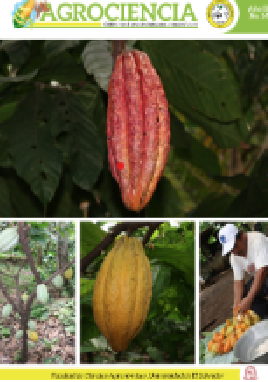
With the aim of establishing field collections of Creole cocoa and robust coffee, a process of collection of Creole cocoa was initiated in different locations in El Salvador of recognized tradition for the cultivation of cocoa. In addition, four clones of robust coffee (Coffea canephora) were acquired from the company INTERLAGOS S.A. DE C.V, from the Mexican company NSIP (Nature Source Improved Plants) and Arabica coffee plants ‘cuscatleco’ variety grafted in nemaya in PROCAFÉ. The cocoa collections were established at the Experimental Station (EEP) and Practices, university campus, San Pedro Nonualco and the Santa Clara Cooperative. With the cocoa germplasm collected, the establishment began from 2016 and coffee acquired until 2018, establishing germplasm of high genetic potential of both species with which it is intended to develop research in order to generate technological packages that can be transferred to Farmers from the immediate areas to the places of establishment, in such a way that the establishment of these crops is promoted among the producers, providing them with propagation material such as the necessary technical advice, trying to promote agroforestry systems (SAF) as an alternative mitigation The ravages of climate change. In conclusion, there are four collections of fine aroma Creole cocoa and three collections of Coffea canephora, which will be available to those who demand them; finally, and with the purpose of guaranteeing irrigation in the f ield collections in the dry season, the EEP well was reactivated, with a submersible stainless steel pump and with submersible motor, with a flow rate of 140 GPM.
References
CATIE (Centro Agronómico Tropical de Investigación y Enseñanza, Costa Rica). 2007. Asegurando Nuestro Futuro. Colecciones de germoplasma del CATIE. Turrialba, Costa Rica. 204 p.
MARN (Ministerio de Medio Ambiente y Recursos Naturales, El Salvador). 2013. Información meteorológica: Servicio Meteorológico Nacional. San Salvador, El Salvador.
Nieto-Ángel, R. 2007. Frutales Nativos. Un recurso f itogénetico de México. Universidad Autónoma de Chapingo. Km 38.5, Carretera México-Texcoco. 270 p.
Parada Berríos, FA; Cruz Pineda, E. 2002. Bancos de germoplasma como material de Propagación de frutales diversificados en los ceda del CENTA. Informe memoria Institucional. Inédito.
Downloads
Published
Issue
Section
License

This work is licensed under a Creative Commons Attribution-ShareAlike 4.0 International License.