Detección de Trichinella spp. en cerdos faenados en el rastro de San Salvador
Keywords:
Trichinellosis El Salvador, Trichinoscopy, TrichinosisAbstract
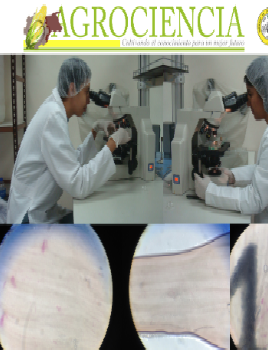
Trichinellosis is a zoonotic disease transmitted from the consumption of pork meat infected by the nematode Trichinella spp. and is included into the Health Code of El Salvador within the most important food-borne diseases that require epidemiological monitoring. The purpose of this research was to evidence the absence of Thrichinella spp. Cyst occurrence in slaughtered swines from San Salvador slaughterhouse through Trichinoscopy. A total of 163 farm swines diaphragm muscle tissue samples were evaluated within a period of five weeks taking samples every day from Monday to Friday. The method used in order to develop the research took basis on Manual of Diagnostic for Terrestrial from OIE, which describes that if both of the pillars of the diaphragm, each pillar must be divided into 14 portions for every tested swine, totalizing 28 evaluated portions for every swine. The obtained results were negative for every of the 4,564 evaluated portions. The results confirm the fact that meat arising from high technical breeding swines from San Salvador slaughterhouse is free of high Trichinella spp. load.
References
Asociación Española de Médicos Internos Residentes. 2006. Triquinelosis Humana. Redalyc (Red de Revistas Científicas de América Latina y el Caribe, España y Portugal) 2(4):1-9.
ASPORC (Asociación Salvadoreña de Porcicultores. 2010 (en línea). Consultado 1 sep. 2016. Disponible http://www.asporc.org/nosotros/rivez Guajardo, EG.; Elías, S. 2006. Triquinelosis una zoonosis vigente. Revista Electrónica de Veterinaria REDVET, 7(5): 1-15.
Marillet, G. 1999. Triquinosis: una zoonosis en aumento. Buenos Aires, AR. Avances en Medicina 99. p. 63 – 71.
Murrel, KD; Pozio, E. 2011. Worldwide Occurrence and Impact of Human Trichinellosis, 1986–2009 (en línea). Emerging Infectious Diseases 17(12). Consultado 30 sep. 2015. Disponible http://wwwnc.cdc.gov/eid/article/17/12/11-0896_article
OIE (Organización Mundial de Sanidad Animal). 2012. Manual Terrestre de la OIE. Capítulo 2.1.20. Triquinelosis. P. 3-8.
Ortega Pierres, MG; Arriaga, C; Yépez Mulia, L. 2000. Epidemiology of trichinellosis in México, Central And South America. Veterinary Parasitology 93: 201 – 225.
Pozio, E. 2007. World distribution of Trichinella spp. infections in animals and human. ScienceDirect Veterinay Parasitology 149: 3 – 21.
Ribicich, M. et al. 2009. Evaluation of the risk of transmission of Trichinellain pork production systems in Argentina. Preventive Veterinary Medicine 159. p. 350-353.
Riva, E; Steffan, PE; Fiel, CA. s. f. Trichinellosis: Aspectos múltiples de una zoonosis global. P: 94-103
Sánchez, S; Sánchez, L. 2006. Triquinelosis: Modelo de Estudio y Técnicas de Diagnóstico Clínico. Madrid, ES. Archivos de Medicina 2.
Schenone, H; Olea, A; Contreras, R, Sandoval, L, Pavletic, B. 2002. Situación de la Triquinosis en Chile. Revista médica de Chile 1992-2002 (en línea) 130(3). Consultado 15 sep. 2015. Disponible http://www.scielo.cl/scielo.php?script=sci_arttextypid=S0034-98872002000300006
Uribarren, T, B. 2011. Trichinelosis (en línea). México. Consultado 10 jun. 2015 Disponible http://www.facmed.unam.mx/deptos/microbiologia/parasitologia/trichinelosis.html
Downloads
Published
Issue
Section
License

This work is licensed under a Creative Commons Attribution-ShareAlike 4.0 International License.