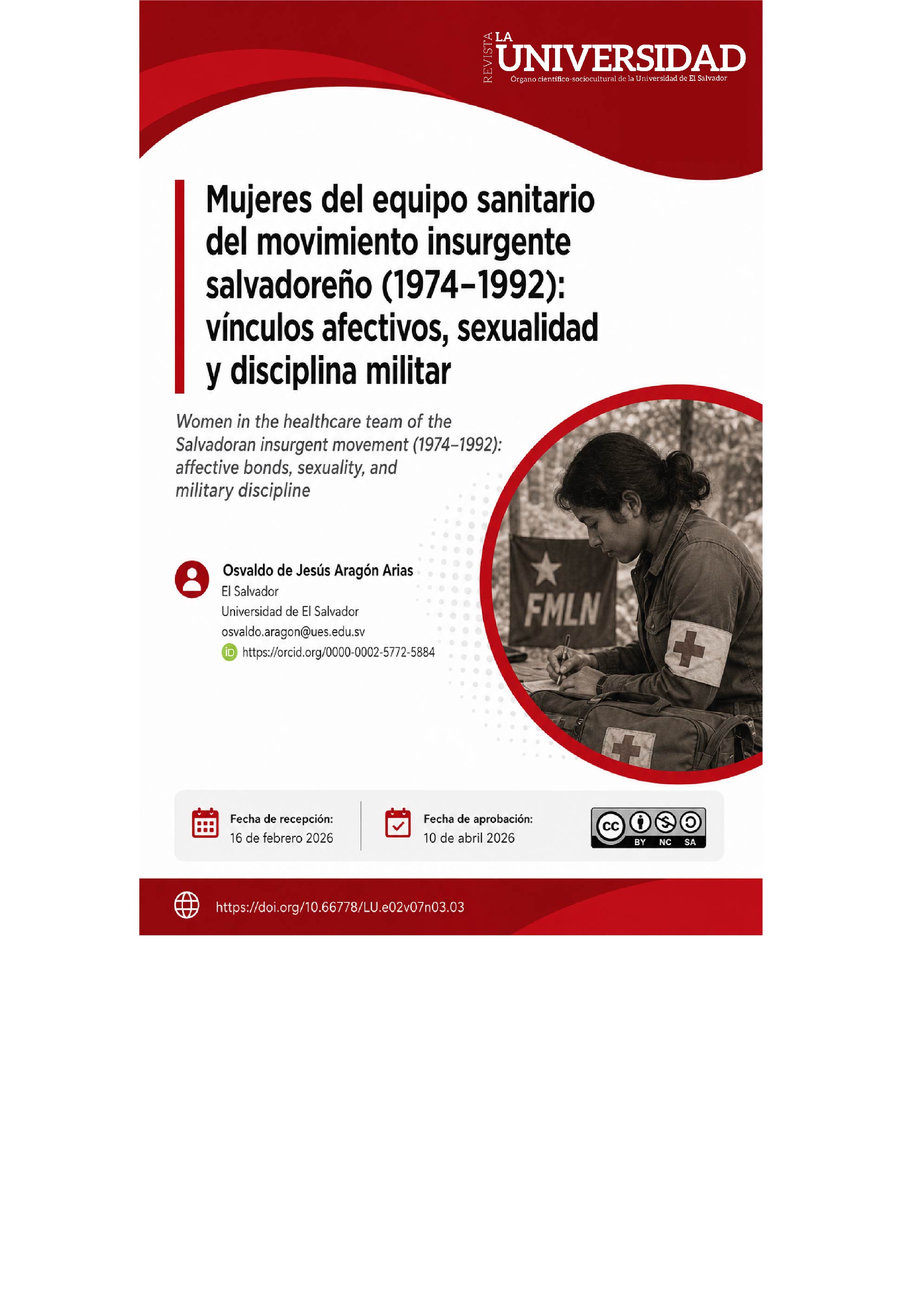
Women in the healthcare team of the Salvadoran insurgent movement (1974–1992): affective bonds, sexuality, and military discipline
DOI:
https://doi.org/10.66778/LU.e02v07n03.03Abstract
Introduction: This article synthesizes a subchapter of the doctoral dissertation Reconstruction of the insurgent healthcare system implemented by the FMLN during the Salvadoran civil war (1974–1992). It analyzes the role of women within the healthcare team and the insurgent military structure, with particular attention to the dynamics of affective and sexual relationships, as well as organizational discipline. Objective: To document insurgent strategies aimed at preventing abuses against women and to analyze their potential replicability in civil and state institutions, with a view toward informing the formulation of inclusive public labor policies, particularly in the health sector. Methodology: The research is qualitative in nature, adopting an oral history approach; the primary technique used was in-depth interviews, complemented by the review of primary and secondary written sources, as well as audiovisual materials, images, and field diary records as additional data collection instruments. Results and discussion: The findings reveal the existence of organizational and disciplinary strategies aimed at protecting the physical, moral, and psychological integrity of women within the healthcare team and among combatants; leadership figures were identified who promoted environments grounded in a gender perspective, functioning as protective factors against potential abuse and fostering more equitable norms of coexistence, as well as greater safety and internal cohesion throughout the conflict. The analysis shows that this perspective emerged progressively and became transversal in the sociopolitical life of the insurgent movement, overcoming internal resistance and transforming power practices. Conclusion: This experience, which constitutes a significant historical reference, is relevant for academic analysis and for the development of inclusive organizational and workplace environments.
Downloads
References
Aguiñada Deras, D. (2016). Una mirada feminista sobre la participación de las mujeres en la guerra: el caso de El Salvador. Hommes armés, femmes aguerries, 13.
Amigos de Funes San Martín, S. M. (2009). Hay muchos a los que no hay que olvidar (Entrada de blog). Amigos de Funes San Martín. https://amigosmfunessanmartin.wordpress.com/
Aragón Arias, O. de J. (en preparación). Reconstrucción de los componentes del sistema de salud insurgente implementado por el Frente Farabundo Martí para la Liberación Nacional. El Salvador, 1974-1992 [Manuscrito inédito].
Che Guevara, E. (1960). La guerra de guerrillas. Titivillus.
Ching, E. (2019). Relatos de la guerra civil en El Salvador: una batalla narrativa. Realidad: Revista de Ciencias Sociales y Humanidades, 153, 23–48. https://doi.org/10.5377/realidad.v0i153.9461
Díaz, N. (2003). Nunca estuve sola (1.ª ed.). UCA Editores.
Gennep, A. van. (2008). Los ritos de paso (J. R. Aranzadi Martínez, trad.). Alianza.
Grenni, H. (2015). El camino hacia la guerra civil: El Salvador en 1979 y 1980. Teoría y Praxis, 26, 55–97. https://doi.org/10.5377/typ.v0i26.2845
Ibarra Chávez, H. Á. (2003). Historias de barro y otros cuentos de la guerra en El Salvador: memorias de un internacionalista.
Luciak, I. A. (2001). Después de la revolución: igualdad de género y democracia en El Salvador, Nicaragua y Guatemala. UCA Editores.
Mariezkurrena Iturmendi, D. (2008). La historia oral como método de investigación histórica. Gerónimo de Uztariz, 23/24, 227–233.
Martín-Baró, I. (1981). La guerra civil en El Salvador. Estudios Centroamericanos, ECA, 36(387–388), 17. https://doi.org/10.51378/eca.v36i387-388.9353
Metzi, F. (2003). Por los caminos de Chalatenango con la salud en la mochila (2.ª ed.). UCA Editores.
Navas, M. C. (2007). De guerrillera a feminista: orígenes de las organizaciones de mujeres postconflicto en El Salvador: 1992-1995. Universidad de El Salvador. https://cedema.fra1.digitaloceanspaces.com/ attachments/1nzizkpzefm5qlcjv4sah4toa7ih
ONU Mujeres. (2025). ONGender equality glossary / Browse by alphabet. https://trainingcentre.unwomen. org/mod/glossary/view.php?id=36&mode=letter&hook=P&sortkey=&sortorder=
Panofsky, E. (1962). Estudios sobre la iconología. Titivillus. https://dn790008.ca.archive.org/0/items/Panofsky-erwin.-estudios-sobre-iconologia-epl-fs-1962-2017/Panofsky%2C%20Erwin.%20-%20Estudios%20 sobre%20iconolog%C3%ADa%20%5BEPL-FS%5D%20%5B1962%5D%20%5B2017%5D.pdf
Peñate Martínez, O. (2011). El Salvador: las negociaciones de los acuerdos de paz (1990-1992) (1.ª ed.). Nuevo Enfoque.
Piedra Guillén, N. P. (2005). Relaciones de poder: leyendo a Foucault desde la perspectiva de género. Revista de Ciencias Sociales, IV (107), 123–141.
Ramírez Acosta, V. E. (2012). La otra cara de la guerra: salvar vidas. FundAbril.
Voigtländer, L. (2022). Lena. En M. Contreras Saiz, T. Louis, y S. Rinke (eds.), Memoria y conflicto: memorias en conflicto. Universidad de los Andes. https://refubium.fu-berlin.de/bitstream/handle/ fub188/34138/9783534274659_Refubium.pdf?sequence=1&isAllowed=y
Downloads
Published
Issue
Section
License
Copyright (c) 2026 Authors who publish in Revista La Universidad agree to the following terms: Authors continue as owners of their works, non-exclusively assigning dissemination rights to La Universidad Journal under the standards of the Attribution-NonCommercial-ShareAlike License: CC BY-NC-SA 4.0. This license allows the use of a work to create another work or content, modifying or not the original work, as long as the author is cited, the resulting work is shared under the same type of license and has no commercial purposes(https://creativecommons.org/licenses/by-nc-sa/4.0/deed.es).

This work is licensed under a Creative Commons Attribution-NonCommercial-ShareAlike 4.0 International License.